An anonymized client case. These timelines describe this project; the scope and follow-up of each migration are assessed individually.
Updating an application often gets caught between two priorities: the business needs to keep running, and the team knows the technology needs attention. The migration gets postponed because it is imagined as a complete rewrite, with months of work and a budget that is hard to justify.
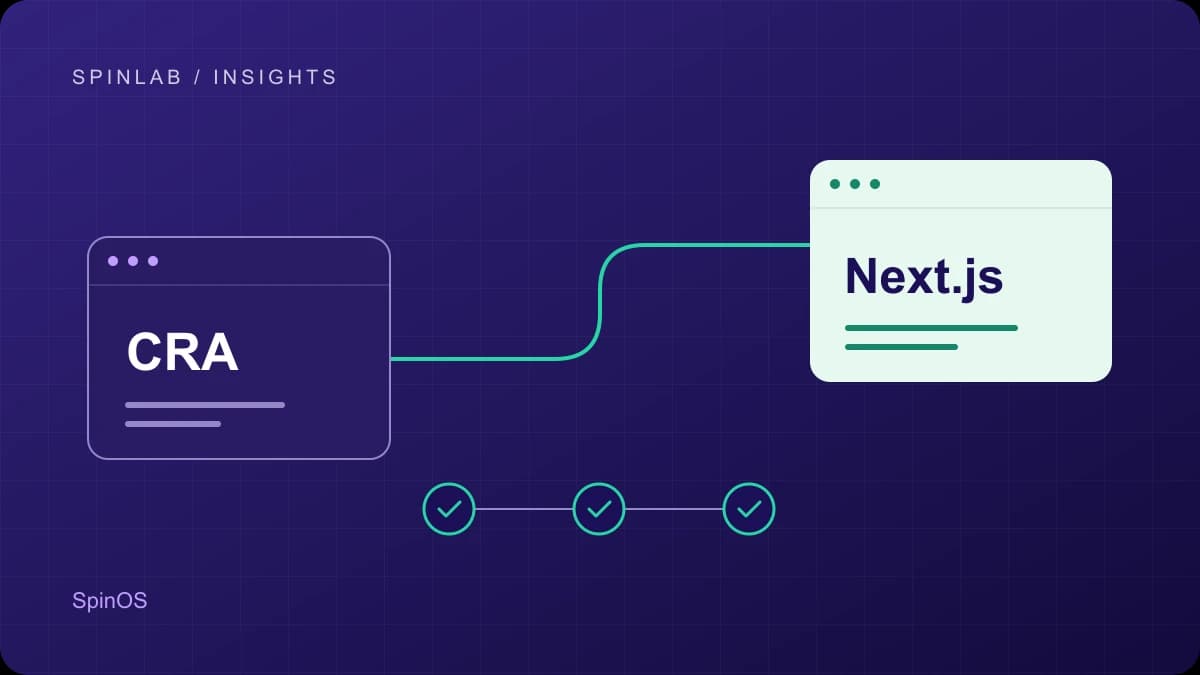
At Spinlab, we migrated an application from Create React App (CRA) to Next.js with support from SpinOS. Development, including QA and end-to-end testing, took two weeks. Including post-launch monitoring, the work was completed in less than a month.
This case opens a useful conversation for companies with a working application: before assuming that an update requires several months of work, it is worth identifying the change they actually need.
The starting point is concrete: what needs to migrate, what needs to keep working, and how we will verify it. From there, we can define a scope that makes sense for the business.
What the migration included
The work combined the migration to Next.js with updating libraries to the latest versions available at the time. It included QA, end-to-end testing and the addition of checklists that enable test automation. A monitoring period followed the launch.
That combination matters when considering the timeline. The two weeks included development and validation; follow-up was part of the total period of less than a month. The speed of this case is meaningful when viewed alongside that full scope.
End-to-end tests check journeys that cross different parts of an application. Checklists help make explicit what needs to be checked and provide a basis for repeating or automating those checks. That work can remain useful when future updates arrive.
Scope is also a business decision. A migration can be defined without automatically including a redesign, new features and rebuilding every integration. Separating those decisions helps assess the effort required and prevents an update from absorbing the entire roadmap.
Where SpinOS contributed
In this migration, SpinOS supported Spinlab’s work. Its role is to connect project context with AI-assisted development and human review. The team remains responsible for technical decisions and the work delivered.
That context matters. An existing application has conventions, dependencies and integrations that need to be understood before making changes. Using AI for a clearly defined task offers a way to accelerate the work while keeping the product’s needs in view.
In this case, that combination supported a concrete delivery: technology migration, updated libraries, QA, testing and monitoring. For anyone considering a similar engagement, the conversation can start with that scope instead of a complete transformation of their platform.
It also changes how the budget should be discussed. Implementation, validation, launch and follow-up need to be visible from the start. That makes it possible to assess a proposal against defined work, its dependencies and its limits, instead of buying a broad promise of modernization.
A launch needs follow-up
Part of a migration’s value lies in being able to observe how the application works after the change. The business needs to know whether people are still completing the actions that matter: signing in, navigating, sending an inquiry or finishing a transaction.
In this project, post-launch monitoring was included in the period of less than a month. For a similar migration, it helps to agree from the start which journeys will be checked, which signals will be observed and who will respond to a deviation. Errors, availability and the outcomes of critical flows provide complementary information.
Comparing those signals with an earlier baseline helps investigate possible effects more carefully. It is also useful to prepare a version to roll back to and define when to do so. Monitoring tools help detect changes; the team interprets the signals and decides how to respond.
This support gives the client something practical: visibility into the change and someone responsible for reviewing what happens. The scope and duration of follow-up are agreed according to the operation being migrated.
A foundation that is easier to maintain
Updating libraries was part of the work delivered. Keeping that foundation current can make it easier to gradually introduce testing, observability and analysis tools that help the team work with less friction.
There is also a wider context: React announced the deprecation of CRA for new applications in February 2025 and recommended evaluating maintained alternatives for existing ones. Next.js offers an incremental migration path; the choice and sequence depend on each product. Sources: React, Next.js.
The aim is to choose technologies that solve a concrete problem. If an addition simplifies updates, clarifies responsibilities or helps detect errors earlier, it has a direct connection to product maintenance. Accumulating tools without that criterion adds work.
Security patches are part of that ongoing work. AI is expanding the capabilities of both attackers and defenders. The UK’s NCSC warns that it can accelerate the exploitation of known vulnerabilities, reinforcing the importance of keeping systems updated. Sources: NCSC.
The operational response involves reviewing relevant advisories, prioritizing according to exposure, testing fixes and verifying their deployment. Next.js and its dependencies need that maintenance too. Planning for it helps prevent every update from becoming an exceptional project.
A more concrete conversation about modernization
Two weeks of development with QA and end-to-end testing. Less than a month including post-launch monitoring. Updated libraries and checklists to automate checks. Those are the results of this case and a concrete reference for discussing a migration with Spinlab.
The opportunity is to define a manageable change, give it a clear budget and plan how it will be observed afterward. Speed of delivery, operational continuity and maintainability are business reasons to evaluate that investment.
If your application is still on CRA and the migration feels too large, we can start by reviewing what exists, what should be kept and what needs to change. With that context, it is possible to assess a concrete scope and a follow-up plan before committing to a larger project.